
- Home
- Service packages
-
- All Industries
- Customs Clearance Automotive
- Customs Clearance Machinery and Plant Engineering
- Customs Clearance Chemical Industry
- Customs Clearance Food and Agri
- Customs Clearance E-Commerce
- Customs Clearance Textile and Apparel
- Customs Clearance Furniture and Wood
- Customs Clearance Pharma and Life Sciences
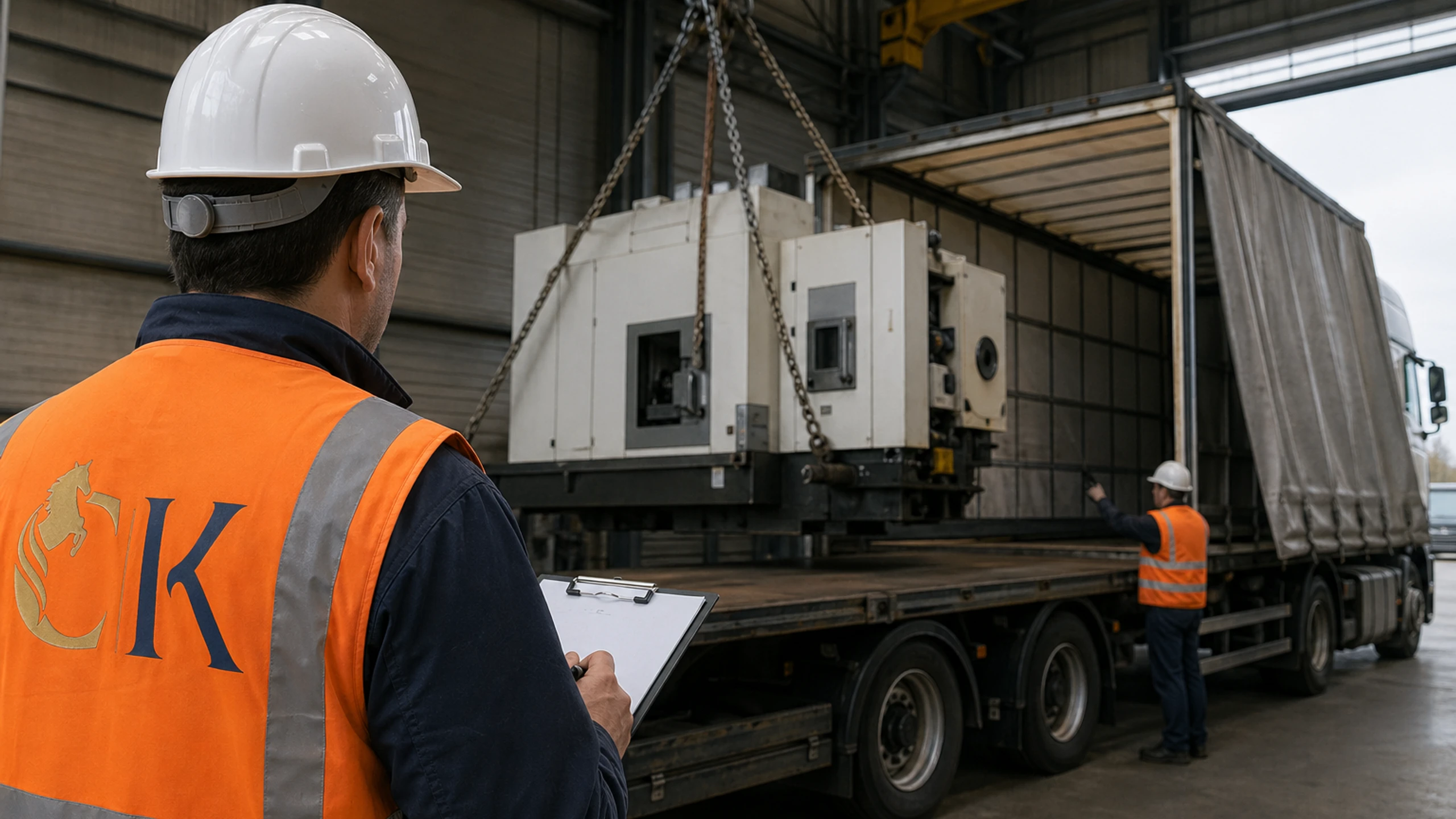
Customs Clearance Machinery and Plant Engineering
- Home
- Industries
- Machinery and Plant Engineering
We clear machine tools, plant components, spare parts and commissioning equipment for machinery and plant builders. You send us the plant list, technical documentation and CE files — we take over import, export, transit, ATA Carnet for trade fairs and service trips, Inward Processing for third-country repairs, Dual-Use classification and the CBAM interface. We classify under the Machinery Directive 2006/42/EC and prepare your files for the Machinery Regulation (EU) 2023/1230 applicable from 20 January 2027. Based in Emmerich am Rhein, serving the NL/BE-DE corridor.
What machinery clients get from us
A seven-figure machine tool, a test rig for an OEM customer in the USA, a tool crossing the Atlantic for repair — every transaction carries customs and export-control exposure in the six-figure range. We hedge that risk systematically: we classify in HS 84–85 with genuine technical depth, we check preference for exports into EU FTA markets (UK, Japan, South Korea, Vietnam, Canada, Singapore), we screen Dual-Use lists under Reg. (EU) 2021/821 before every non-EU export, we apply for ATA Carnets for trade fairs and service deployments, we open Inward and Outward Processing for repair flows in both directions, and we identify CBAM liability on steel- and aluminium-intensive components. You receive a documented audit trail for every transaction.
Trust anchors at a glance
Typical machinery customs scenarios
- Imports of machine tools, components and spare parts from Asia and the USA - T1 from Rotterdam and Antwerp, ATLAS-Import at the inland customs office near the plant.
- Export of complete plants (packaging lines, machine tools, process plants) to non-EU countries - EAD, preferential proofs, sanctions screening, end-use documentation.
- Tool transport for installation and commissioning at the non-EU customer - ATA Carnet, temporary admission.
- Service and repair exports: a unit goes to the customer, returns for repair in the EU - Outward Processing, repair customs value.
- Non-EU component arrives for EU repair, returns repaired - Inward Processing under Art. 256 UCC authorisation.
- Trade fair exhibits at EMO, Hannover Messe, IMTS Chicago - Carnet plus forwarding plus on-stand customs handling.
- Plants with steel/alu components above CBAM threshold - annual CBAM declaration and certificate obligation since 2026.
Machinery Directive 2006/42/EC and Machinery Regulation 2023/1230
On imports from non-EU countries, we verify the CE documentation under Machinery Directive 2006/42/EC — declaration of conformity, operating instructions in the required official language — we classify high-risk machinery groups under Annex IV and we hold shipments that arrive without a notified-body certificate. From 20 January 2027, Machinery Regulation (EU) 2023/1230 replaces the Directive, extending scope to cybersecurity, AI components and autonomous mobile machinery and tightening importer obligations. We already prepare your import files for the new regime. For exports to markets with equivalent standards — UK UKCA, Swiss CH-MachV — we coordinate documentation requirements with your engineering team. You receive a CE-status list for every shipment.
Tool transport, ATA Carnet and temporary admission
- Service technician flies with test rig, metrology, special tools to an OEM customer in Mexico - ATA Carnet avoids double duty and security.
- Commissioning a plant in Saudi Arabia: tool and dismantling equipment on Carnet, classical plant export alongside.
- Trade fair exhibits at EMO Hannover (intra-EU) versus IMTS Chicago (USA, Carnet recipient).
- The ATA Carnet can currently be used in 77 countries - not every country accepts it for every purpose.
- We apply for Carnets through the competent Chamber of Commerce, manage stamping discipline at offices of entry and exit, close the Carnet cleanly and submit evidence in case of lost stamps.
Inward and Outward Processing for repairs
You ship a customer unit across the Atlantic for repair, or a third-country customer sends their machine to your EU plant — we clear both directions. Under Outward Processing (Art. 259 UCC) we declare only the repair value on return (material plus labour plus a proportionate share of transport cost), not the full asset value. Under Inward Processing (Art. 256 UCC) we admit the third-country goods without levying import duties, you repair, and we re-export. We apply for the authorisations, maintain the procedure account and close it cleanly. You send us the repair order, unit data and the target return date — we deliver the procedure codes and the final customs confirmation.
Dual-use and export control
Before every non-EU export we screen against Dual-Use Regulation (EU) 2021/821 — Annex I, II and IV — check the military end-use catch-all and verify destination-country embargos. High-precision machine tools (5-axis machining, micrometre tolerance), sensors and control electronics all appear in the annexes. You send us technical datasheets and end-customer particulars; we issue the classification note and, where a licence is required, we file the BAFA authorisation. We manage the BAFA lead time — often several weeks — we screen business partners against sanctions lists and we document the complete audit trail for your compliance record. Without a documented audit trail you face criminal exposure under the Foreign Trade and Payments Act (AWG).
AEO, ICS2 and Centralised Clearance for Import (CCI)
If you have a significant share of foreign trade, we guide you through the AEO application — AEOC, AEOS or AEOF — including self-assessment, security concept and the OEA audit checklist. You gain reduced control rates, faster releases, Entry in the Declarant's Records (EIDR) and access to Centralised Clearance for Import (CCI), which went live with ATLAS 10.2 on 28 February 2026. We build the internal processes with your team to make them audit-proof, and we activate the authorisations in day-to-day clearance. For ICS2 pre-arrival ENS filings we supply the required data depth — generic descriptions such as 'machine parts' trigger 'do not load' risk, which we eliminate through precise commodity input.
CBAM on steel and aluminium components
If you import semi-finished products or high-metal-content components from non-EU countries, CBAM Regulation (EU) 2023/956 applies to you — it covers steel, aluminium and ironware under HS chapters 72, 73 and 76 in Annex I. Since 1 January 2026 the definitive phase is in force: you need CBAM certificates, emissions evidence from the non-EU manufacturer (or default values) and an authorised CBAM declarant. We identify the CBAM obligation per TARIC position from your bill of materials, we request emissions data from the supplier and we take over the reporting and certificate obligation in full. You receive the annual CBAM declaration and a reconciled certificate account.
Pitfalls we avoid
- Under-classification due to too generic machinery description - risk of anti-dumping hits and CE documentation gaps.
- Dual-use export without BAFA authorisation - breach of the Foreign Trade Act with fines and criminal prosecution.
- Carnet not closed - guarantee forfeited, the Chamber charges the account.
- Repair without processing authorisation - double duty or duty on the full value instead of the repair value.
- ICS2 too generic - 'spare parts machinery' triggers a 'do not load'.
- Machinery Directive / 2027 Regulation ignored - market ban, recall, damages.